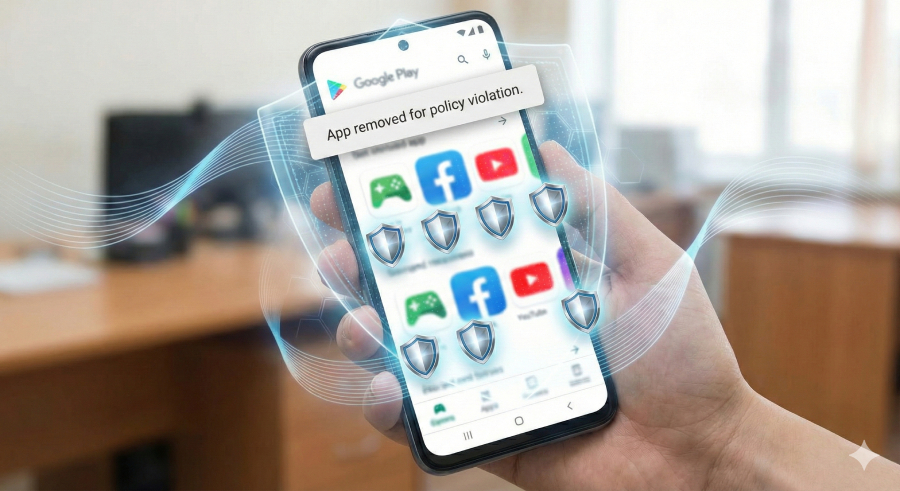
Google relied on expanded AI-driven review systems and stronger front-end controls to block more than 1.75 million policy-violating apps from reaching Google Play in 2025.It also banned more than 80,000 developer accounts tied to attempts to publish harmful software, showing the volume of abuse targeting the Android ecosystem.The figures reflect enforcement actions taken last year and highlight how the tech giant is trying to stay ahead of attackers who are refining their tactics.
For app makers, enterprise mobility teams, and billions of Android users, the message is clear: more screening is happening before an app ever appears in the store.Google uses AI and layered checks to filter apps before launch According to Google’s Security Blog, the company added newer generative AI models to its review workflow to help human reviewers more quickly identify complex malicious behavior.Every app submitted to Google Play runs through more than 10,000 safety checks before publication, and monitoring continues after apps go live.
Google also credited tighter developer controls, including identity verification, pre-review checks, and expanded testing requirements, with making it harder for repeat offenders to resurface under new accounts.Privacy misuse and fake reviews remain persistent issues Not all enforcement centers on outright malware.Google said it blocked more than 255,000 apps from accessing what it considered unnecessary or excessively sensitive user data, reflecting continued pressure around privacy permissions.
The company also targeted manipulation inside the store.Its systems blocked 160 million spam ratings and reviews in 2025 and limited the impact of coordinated review bombing, preventing an average 0.5-star rating drop for affected apps.For younger users, Google said it added safeguards to reduce exposure to apps tied to gambling or dating.
Play Protect focuses on threats beyond the store Risk does not start and end with Google Play.Many attacks originate from sideloaded apps or downloads delivered through browsers and messaging platforms.Google said Play Protect now scans more than 350 billion Android apps daily across both Play and non-Play sources.
Last year, its real-time detection systems identified more than 27 million new malicious apps distributed outside Google Play and either warned users or blocked installations.The company expanded enhanced fraud protections to 185 markets, covering more than 2.8 billion Android devices.That feature blocked 266 million risky install attempts and shielded users from 872,000 unique high-risk apps last year.
Google also added protections designed to counter phone-based scams by preventing users from disabling Play Protect during active calls, a common tactic used in social engineering schemes.More Google coverage New Google Search AI Mode is ‘Total Reimagining,’ Says CEO Sundar Pichai In Major Ruling, Judge Finds Google ‘Willfully Acquired and Maintained Monopoly Power’ Over Digital Ad Market Google’s Big Bet on Nuclear Energy: ‘The Race to Power AI-Driven Data Centers is Accelerating’ Computer History Museum Releases Original AlexNet Code: Why It Matters Verification and Android 16 aim to limit repeat abuse To address repeat offenders, Google said it is broadening developer verification requirements beyond the Play Store to the wider Android ecosystem.It also introduced a limited-distribution account option for students and hobbyists.
On the platform side, Android 16 will include additional safeguards for sensitive data such as banking credentials, along with protections against “tapjacking,” where malicious apps use hidden overlays to hijack user taps.Bigger picture: Prevention is the strategy The scale of blocked apps and banned accounts illustrates the steady pressure facing open app ecosystems.Google’s approach centers on filtering out harmful software before publication, tightening developer accountability, and strengthening on-device protections when apps come from outside official channels.
As attackers adopt automation and AI to scale their efforts, Google is responding with more automation of its own to intercept abuse earlier and reduce the odds that harmful apps ever reach users.The debate over app safety extends beyond mobile stores, as Mark Zuckerberg faces questions about Instagram’s effects on young users.Subscribe to the Google Weekly Newsletter Learn how to get the most out of Google Docs, Google Cloud Platform, Google Apps, Chrome OS, and all the other Google products used in business environments.
Delivered Fridays Subscribe to the Google Weekly Newsletter Learn how to get the most out of Google Docs, Google Cloud Platform, Google Apps, Chrome OS, and all the other Google products used in business environments.Delivered Fridays
Read More